Peak demand and energy arbitrage
Battery sizing and business case for lowering peak demand charges and moving energy use into lower priced periods.


Battery sizing and business case for lowering peak demand charges and moving energy use into lower priced periods.
Storing midday solar for use at the evening peak, and sizing solar and storage together.
Storage, load management or a staged connection to get supply on sooner and at lower cost than a network upgrade.
Fleet and depot charging where the existing connection is the limit, with a battery supplying the charging peaks.
Central plant for villages, subdivisions and mixed use sites that reduces the connection the development needs.
Load estimates, connection strategy, plant space and coordination with the network company.
Each engagement runs in a secure project space in ASKA Tungsten. Interval data, drawings, network correspondence, model runs and reports are held in one place, with a register of every document issued and the actions and decisions that follow.
The client, their engineers and the developer work from the same record, and it stays with the project into construction and operation.
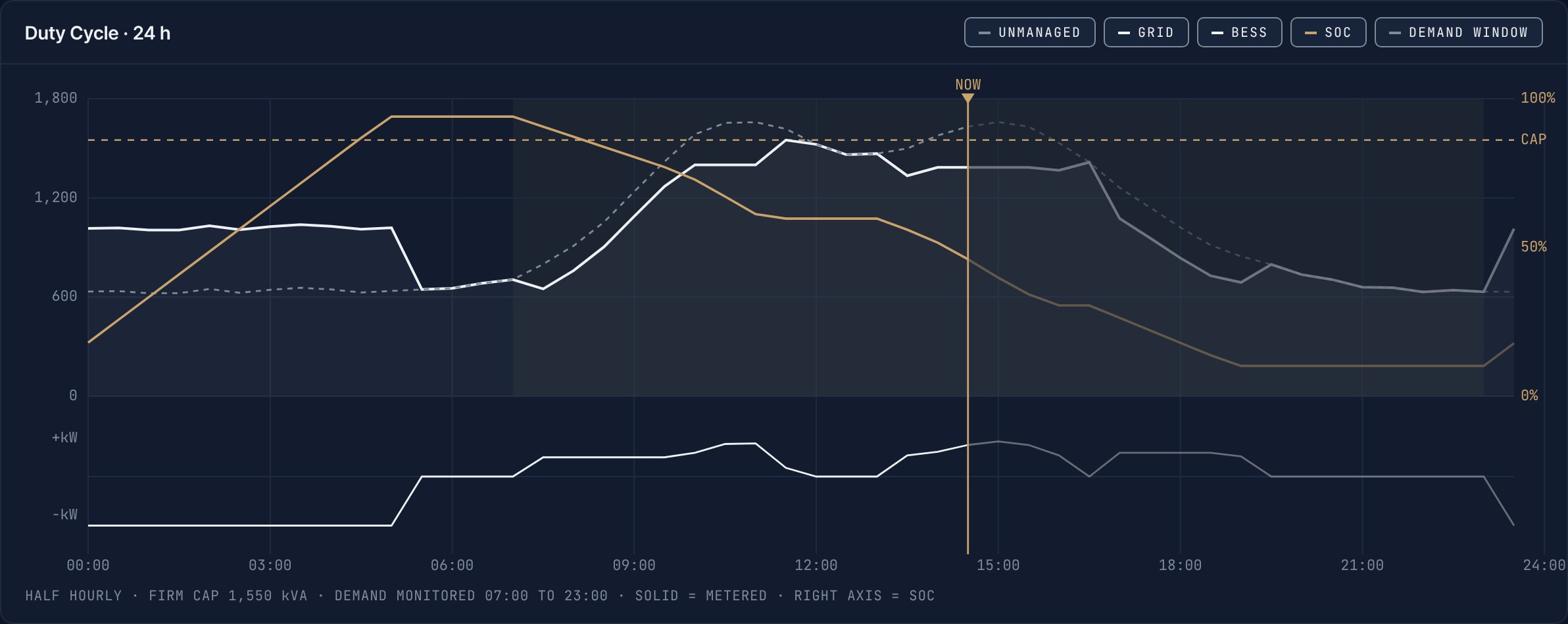
The model built for the business case is the same engine that runs the battery once it is installed. Savings are measured each month against the figures in the original report, on the same tariff and the same assumptions.
When results move away from the model, the record shows why: a tariff change, a change in site load, or the battery itself.
Whether storage, solar or a change to the connection suits the site, and what it would save.
The chosen option worked up for an investment decision.
Work with the network company on the site's connection and charges.
The system designed and specified to be built.
Energy centre
Energy centre design that holds the development to a managed 450 kVA connection with storage, in place of about 770 kVA of unmanaged demand.
Business case
Storage sized to seasonal refrigeration peaks, with a modelled payback under 5 years.
Feasibility
Battery storage modelled on the village's half hourly data and network tariff.