Models the site
Twelve months of half hourly data, the network tariff and local prices are modelled to size the battery and set the expected savings.


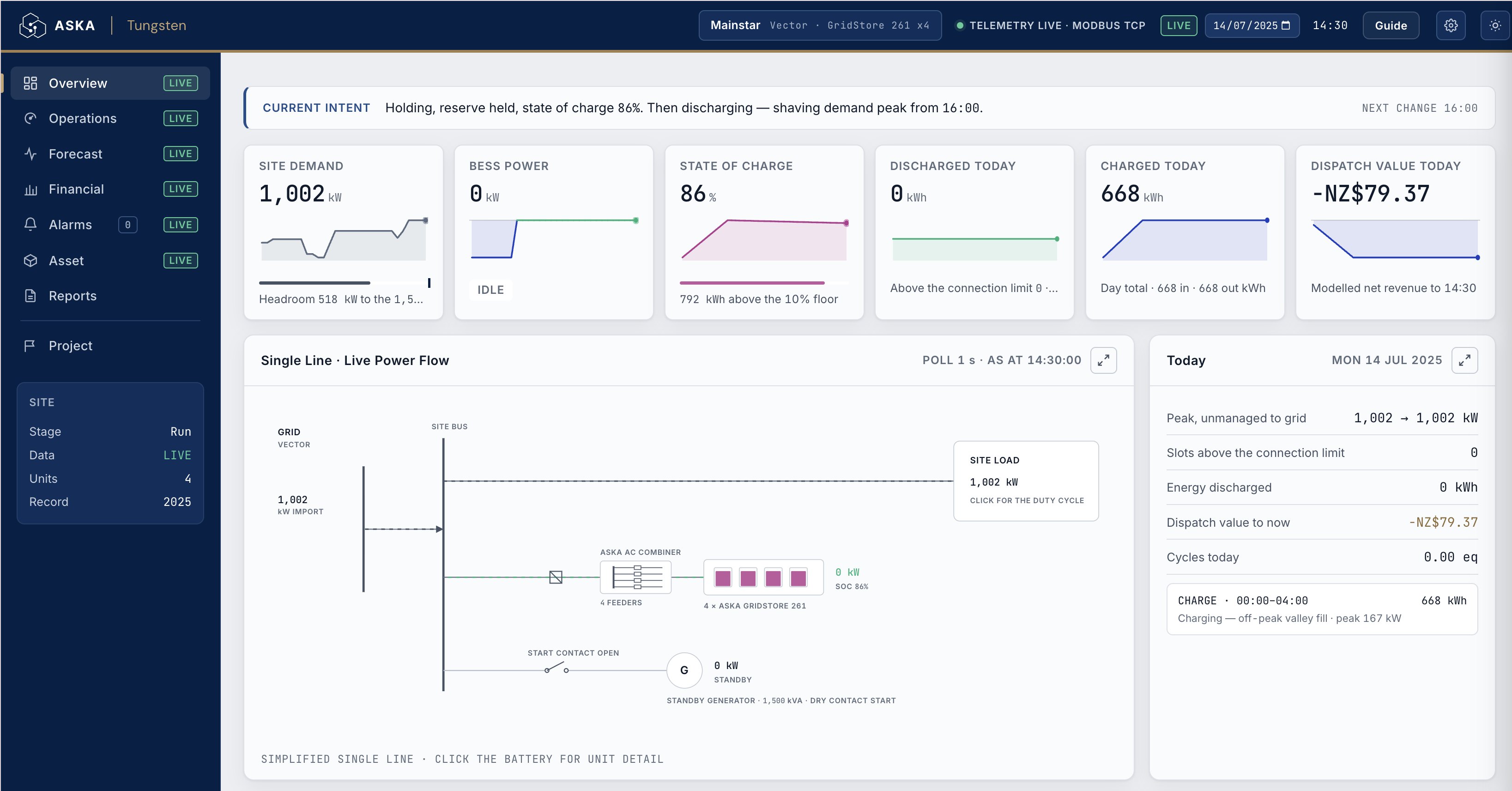
Twelve months of half hourly data, the network tariff and local prices are modelled to size the battery and set the expected savings.
Forecasts site demand and prices and sets charge and discharge for every cabinet, every half hour.
State of charge, cell temperatures and voltages, alarms and availability for each cabinet, held in one record.
Savings by stream each month, measured against the baseline locked at commissioning.
Tungsten also holds the project space for consulting work. Consulting
One schedule covers every stream. Tungsten weighs them each half hour against the battery's state of charge and the cycles it has left.
Peak demand
Discharges through the site's highest half hours so the demand the network bills on is lower. Measured as billed peak against the baseline peak.
Capacity
Holds network import under the connection limit as new load is added. Measured half hour by half hour against the limit.
Energy arbitrage
Charges overnight or from midday solar and discharges when wholesale prices are highest. Measured at the site's grid exit point prices.
Flexibility
Responds to network and market flexibility events within limits agreed with the site. Measured as events called, delivered and paid.
Each half hour Tungsten records what the battery did and why: charging in the overnight valley, discharging to hold the demand peak, the energy moved and what it was worth. The same record feeds the monthly report.
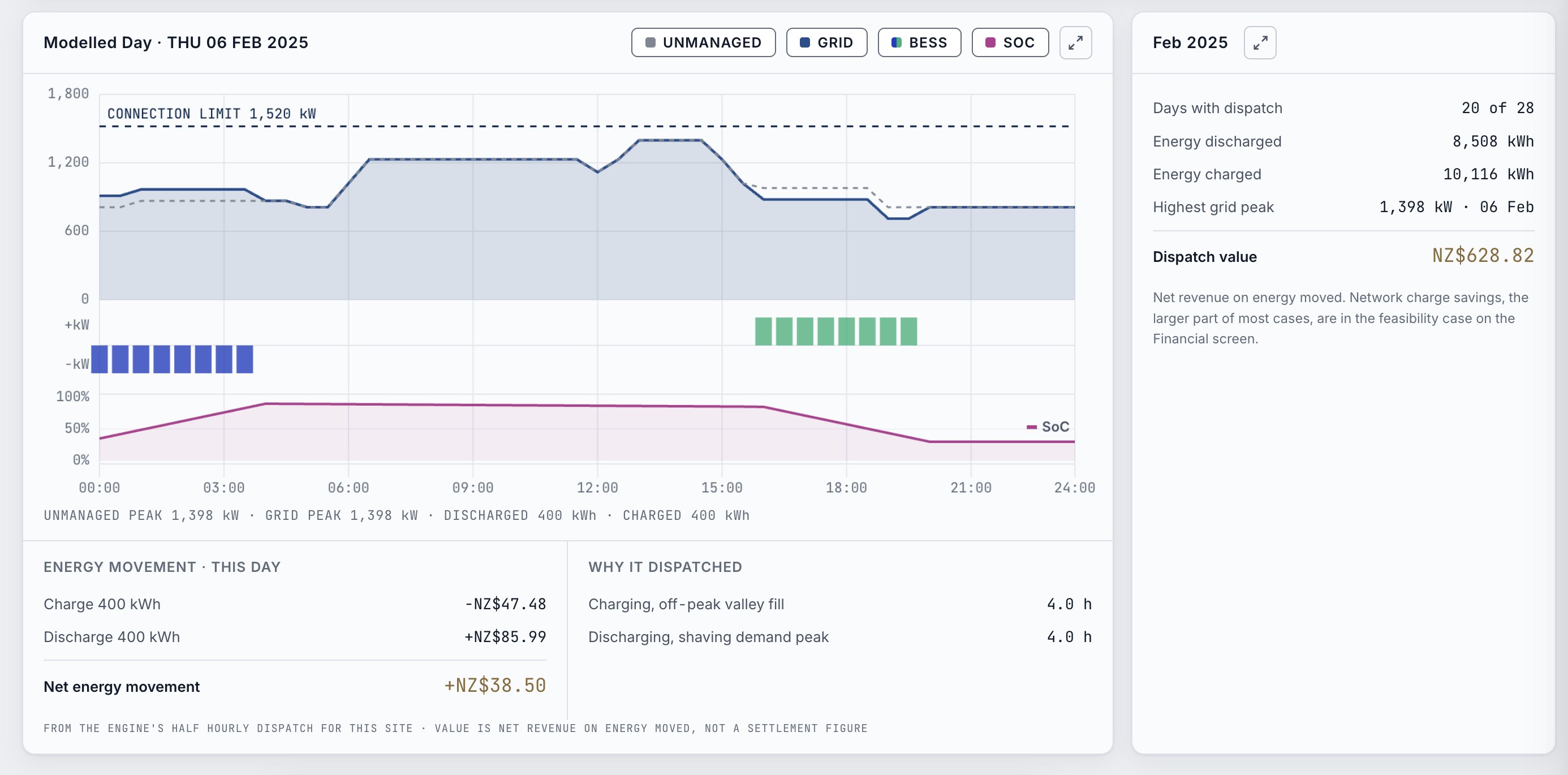
Each cabinet is addressed on its own and takes instructions only from Tungsten. The site gateway connects out to Tungsten to collect the schedule. Nothing outside can connect in to command a cabinet.
A schedule is applied only within the operating limits set for the site.
ASKA manages all site data and every login that can see it. Data is held on servers in the Australasian region and is not stored or processed outside it.
Each figure is measured from metered dispatch and set against the model the business case was built on, on the same tariff and assumptions.
When the site changes, Tungsten compares recent load with the same working days a year earlier and recasts the forecast if the difference falls outside a set band.
The business case model sizes the system and sets the expected savings.
The baseline is locked at go live, on the tariff in force on that day.
Tungsten runs the battery every half hour and records each decision.
Monthly results against the baseline, with any difference explained.